Receipt book vs invoice book: what’s the difference?
An invoice requests payment, while a receipt confirms payment has been received. So an invoice book is used to bill a customer before they pay, and a receipt book is used to acknowledge a payment after it is made. They look similar, but they do different jobs.
What an invoice does
An invoice is a request for payment. It lists what was sold, the amount owing, GST, and payment terms. In Australia a valid tax invoice also shows your business name, ABN and the words “Tax invoice”. You issue it before (or at the time of) the sale.
Think of the invoice as the bill. It tells the customer exactly what they owe, for what, and by when — the payment terms might be due on receipt, seven days, or thirty. It is the document that starts the clock on getting paid, and it is the one your bookkeeping treats as money owed to you (a receivable) until it is settled. Because it is a tax document, leaving off the ABN or the GST detail can make it fall short of a valid tax invoice, which causes problems for a customer trying to claim the GST back.
What a receipt does
A receipt is proof that payment was made. It confirms the amount paid, the date, and what it was for. Customers keep receipts for their records, warranties or expense claims. You issue it after the money changes hands.
The receipt is the acknowledgement — it closes the loop the invoice opened. Once the customer has paid, the receipt is their evidence they did, which they may need for a warranty claim, a tax deduction, an expense reimbursement or simply their own records. For you, issuing a receipt confirms the sale is settled and gives you a matching record that the invoice has been paid. In a cash sale where no invoice was ever raised, the receipt often does both jobs at once — it records the sale and confirms the payment in a single document.
Which do you need?
- Billing customers who pay later: an invoice book.
- Confirming cash or on-the-spot payments: a receipt book.
- Both situations: many businesses carry both, or a book that covers both.
The right choice follows how you get paid. If you do the work first and bill afterwards — trades, consultants, suppliers on account — an invoice book is your core tool. If you take payment on the spot and just need to confirm it — a market stall, a cash-in-hand service, a counter sale — a receipt book fits better. A lot of businesses sit in both worlds across a week, which is why carrying both, or a combined book, keeps you covered whatever the transaction.
How the two work together
In a typical credit sale the documents run in sequence: you finish the job, hand over or email an invoice, the customer pays against it, and you issue a receipt confirming the payment. That paper trail — bill, then proof of payment — is exactly what your records, and the ATO, want to see. Numbered books make the trail easy to follow, because every invoice and every receipt has a unique number you can match against your bank statements at BAS time.
Common mistakes to avoid
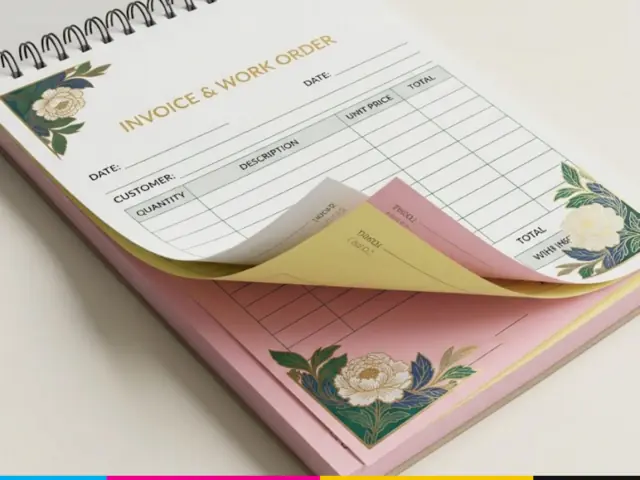
People often use the words interchangeably and hand a customer the wrong document — giving a receipt when the customer still owes money, or an invoice when they have already paid, confuses everyone’s records. Other slips: forgetting the ABN or “Tax invoice” wording on an invoice, not numbering the books so nothing reconciles cleanly, and keeping no copy for yourself. A duplicate or triplicate carbonless book fixes the last two by creating your record automatically as you write.
Frequently asked questions
Can one document be both an invoice and a receipt?
In a paid-on-the-spot sale, effectively yes — a receipt that itemises the sale and confirms payment can stand in for both. For sales paid later, you generally want a separate invoice first and a receipt once the money arrives.
Does a receipt need to show GST and an ABN?
If the receipt is doubling as a tax invoice for a GST sale, it should carry the same details — business name, ABN, “Tax invoice”, and the GST amount. A plain payment receipt for an already-invoiced sale can be simpler, since the tax detail is on the invoice.
Should my books be numbered?
Yes. Sequential numbering is what lets you reconcile invoices and receipts against your bank records and spot anything missing. We print books with pre-numbered pages as standard.
Duplicate or triplicate — which should I choose?
Duplicate gives you two copies (customer and you); triplicate gives three, useful when a copy also goes to an accounts file or a second location. Both use carbonless paper, so one write-through fills every copy.
We print custom, branded and numbered invoice and receipt books, in duplicate or triplicate. See our invoice book printing or get a quote.